
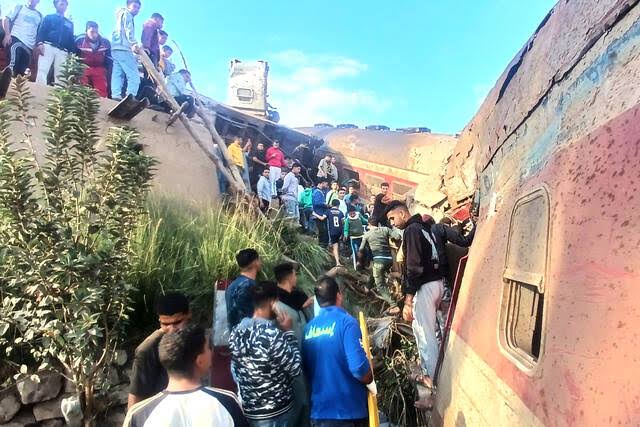
At least seven people have been killed and more than 100 injured after two passenger trains collided south of Cairo, Egyptian authorities said, in the latest deadly accident on a railway network long troubled by fatal crashes.
The collision happened between the Kafr Ammar and Al-Raqqa stations in the Al-Ayyat area of Giza, roughly 50 kilometres south of the capital. According to the country’s railway authority, a train travelling from Giza to Fayoum ran into the rear of a stationary train bound for Aswan from Cairo, sending several carriages off the tracks and down an embankment. The driver of one of the trains was among the dead.
President Abdel Fattah al-Sisi said he had ordered the relevant authorities to investigate the cause and to hold anyone found negligent to account. The public prosecutor’s office opened an inquiry and cautioned that the death toll could rise as rescue teams continued to search the wreckage. The Health Ministry said hospitals near the scene had been placed on alert, and the Egyptian Red Crescent deployed staff to treat the injured and support families at the site.
The Health Minister, Khaled Abdel Ghaffar, said casualties were being treated for injuries that included fractures and head wounds. Train services between Giza and Upper Egypt were suspended while cranes removed the damaged carriages, and the railway authority did not say when they would resume.
The crash has renewed scrutiny of a system responsible for some of the worst transport disasters in the country’s history. The site lies close to where Egypt’s deadliest railway accident occurred in February 2002, when a fire tore through a crowded train heading south from Cairo and killed at least 373 people, though some accounts put the toll higher. Two further accidents in the same area in 2009 claimed dozens of lives.
More recent disasters have followed a similar pattern of trains running into one another. In March 2021, a collision near Tahta in Sohag killed at least 18 people and injured more than 100, after the emergency brakes on one train were triggered and a second train struck it from behind. In 2019, a locomotive crashed into a barrier at Cairo’s main Ramses station and burst into flames, killing more than 20 people and prompting the transport minister of the day to resign. A collision outside Alexandria in 2017 killed about 43.
For years, the scale of the problem was measured in the thousands. Figures compiled by the Central Agency for Public Mobilization and Statistics recorded 1,793 train accidents in 2017 and 2,044 in 2018, covering everything from minor derailments to fatal collisions on a network that carries hundreds of millions of passengers a year.
The numbers have since fallen sharply. The same agency reported that train accidents dropped by 22.7 percent to 170 incidents in 2025, down from 220 the previous year, with 39 deaths and 139 injuries recorded over the year. The severity of accidents also eased, from 54.8 deaths for every 100 people injured in 2024 to 28.1 in 2025. The decline has coincided with a long and costly overhaul of signalling, tracks and rolling stock, a programme the government has estimated would require hundreds of billions of Egyptian pounds to complete.
That progress has not silenced criticism. The latest crash drew fresh calls for the transport minister to step down over the recurring accidents, echoing the political fallout that has followed previous disasters. Successive governments have promised to modernise the railways, yet each new collision reopens questions about maintenance, oversight and whether reforms are reaching the oldest and busiest stretches of track.
Messages of sympathy came from beyond Egypt’s borders. Saudi Arabia’s foreign ministry expressed solidarity and wished the injured a quick recovery, while Turkey’s ambassador conveyed condolences to the victims, their families and the Egyptian people. For now, investigators have yet to establish why the first train was stationary on the line or why the second failed to stop in time, the central questions the inquiry ordered by the president will need to answer.