
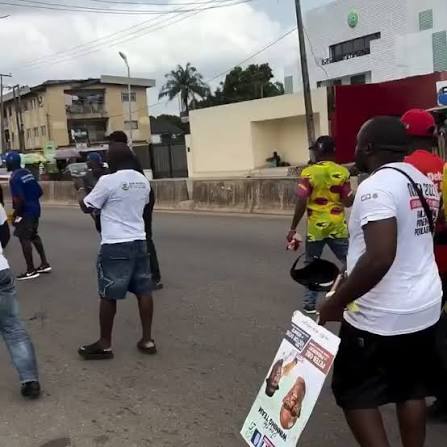
One person has been killed and four others seriously injured after a campaign procession by supporters of the Nigeria Democratic Congress presidential candidate, Peter Obi, turned violent in Asaba, with the Delta State Government and the police blaming the organisers for ignoring a warning to hold the event at a secured venue.
The clash broke out around 12.15pm on Saturday along Nnebisi Road, one of the busiest routes in the Delta State capital, as members of the Obidient and OK movements marched in support of Obi ahead of the 2027 general elections. Police operatives who responded to a distress call moved the injured to hospital, and security was later reinforced in the area to prevent a wider breakdown of order.
In the government’s account, the Commissioner for Works (Rural Roads) and Public Information, Charles Aniagwu, said the police had advised the organisers to cancel the street march and assemble instead at a designated venue where security could be guaranteed. He said that advice was ignored, and described the resulting death and injuries as unacceptable, insisting that the state operates a zero tolerance approach to political violence regardless of party affiliation. Aniagwu called for a thorough investigation and the prosecution of anyone found responsible, and maintained that Delta remained safe for residents and visitors.
The police gave a similar account. The command’s spokesperson, Bright Edafe, said officers had received intelligence pointing to the likelihood of violence and had invited the organisers to a security meeting, where they were briefed on the threats and advised against an open road procession. The Commissioner of Police, Samuel Erale, condemned the violence but stressed that parties remained free to campaign lawfully, urging them to avoid road marches and to notify the police before gatherings so that protection could be arranged. He said the identities of the victims were yet to be established and appealed to anyone with useful information to come forward.
The organisers had not issued their own account of the clash by the time of writing. Supporters of the movement have complained of similar hostility before, however. During a campaign outing in Warri on 18 September, backers of Obi and his running mate, Rabiu Kwankwaso, alleged that they were set upon by politically sponsored thugs, an accusation that has so far produced no charges.
The latest death lands at a tense moment. Obi, who finished third in the 2023 presidential election on the Labour Party platform, emerged as the NDC candidate in May after leaving the African Democratic Congress, and will face President Bola Tinubu of the All Progressives Congress and former Vice President Atiku Abubakar of the ADC when Nigerians vote on 16 January 2027, now just over two months away.
Delta has long been one of the country’s electoral flashpoints. In its tracking of the build up to the 2023 general elections, the Centre for Democracy and Development recorded at least 109 election related deaths nationwide, and listed Delta among the states with the highest number of violent incidents, alongside Lagos, Rivers, Kano and Anambra. The longer record is heavier still. International observers put the toll from the 2019 general elections at about 150 lives, while the 2011 polls, the deadliest of the Fourth Republic, left roughly 800 people dead.
Those figures explain why a single clash at a roadside procession draws such concern. Campaign season in Nigeria has repeatedly turned rallies, motorcades and party offices into sites of confrontation, and the warnings from Asaba point to familiar triggers: large street gatherings, thin security cover and rising partisan feeling. For now, the open questions are who the victims were, who fired the shots, and whether the investigation the government has promised will deliver arrests where so many earlier cases have not.