
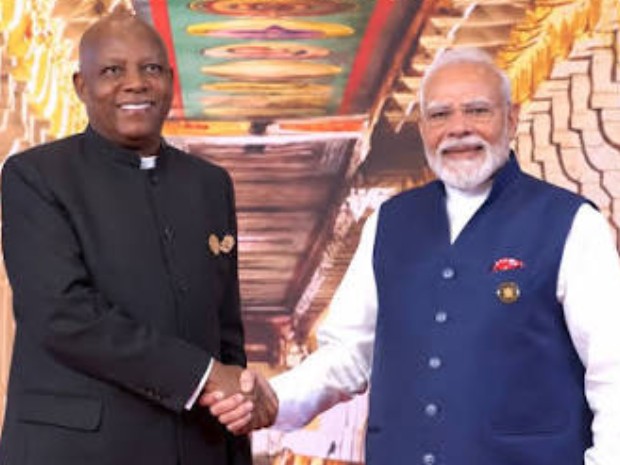
Nigeria demanded a sweeping overhaul of the United Nations Security Council and international financial institutions at the 18th BRICS summit in New Delhi on Sunday. Vice President Kashim Shettima delivered the rebuke on behalf of President Bola Tinubu, telling world leaders that post-war multilateral structures fail to reflect modern demographic and economic facts. The Nigerian delegation argued that the rules governing international credit, emergency borrowing, and diplomatic security remain frozen in 1945. Emerging economies generate nearly half of global output, yet Western capitals still hoard voting control inside the World Bank and International Monetary Fund. Shettima urged the expanded bloc to lead the campaign for institutional parity rather than settling for cosmetic committee adjustments. African nations refuse to accept permanent junior status in international councils. The existing global order protects established privileges rather than equity.
The speech exposed the deep frustration that developing nations harbour toward Western credit policies. African countries borrow at punitive interest rates on international capital markets because sovereign rating agencies consistently mark down their credit risk. Those punishing spreads force cash-strapped governments to spend scarce revenue servicing foreign loans rather than funding hospitals, roads, or domestic power grids. Shettima pointed out that the multilateral financial architecture must lower the cost of green capital and infrastructure loans for the Global South. International lenders demand strict fiscal austerity from developing states while industrialised polluters consume cheap debt without similar penalties. Abuja wants multilateral development banks to broaden credit access without attaching intrusive political conditions. Decades of Western debt medicine have produced fiscal distress rather than industrial prosperity. Cheap credit remains the only real engine of structural growth.
Nigeria used the New Delhi summit to position itself as the commercial gateway to the wider African continent. Shettima pitched the country’s young population, extensive gas deposits, and reforming internal market to major sovereign wealth funds gathered at Bharat Mandapam. The Nigerian team wants foreign investors to buy into local fertiliser manufacturing, telecommunications backbones, and port logistics rather than exporting unprocessed commodities. Foreign Minister Bianca Odumegwu-Ojukwu noted that India’s agricultural mechanisation models offer practical lessons for Nigerian farm yields. Industry Minister Jumoke Oduwole spent the weekend meeting Asian industrial barons to revive bilateral trade that previously hit 14 billion dollars. Abuja wants industrial factories built on Nigerian soil to curb its crushing dependence on imported manufactured goods. Signing trade declarations will achieve little without foreign companies investing actual cash into local plants.
The timing of Nigeria’s intervention coincides with an unprecedented expansion of the BRICS political universe. The group now commands eleven full members, including oil-producing giants Saudi Arabia, Iran, and the United Arab Emirates, alongside African representatives Egypt and Ethiopia. Nigeria joined the outer orbit as an official partner country in January 2025 alongside Malaysia, Vietnam, and Kazakhstan to test multilateral waters without burning Western bridges. The expanded alliance accounts for nearly half the world population and over forty per cent of global economic output. Shettima noted that this sheer demographic heft gives the bloc the moral authority to challenge unipolar rules. Western capitals can no longer pretend that their domestic priorities represent the universal interests of mankind. The global balance of power has shifted eastward and southward.
The geopolitical backdrop gave Shettima’s address an urgent edge. Maritime clashes around the Strait of Hormuz and the Bab el-Mandeb strait have choked regional shipping, pushing crude oil prices past 100 dollars per barrel. Developing economies that import fuel and industrial machinery bear the brunt of these supply disruptions and the inflation that follows. The weaponisation of currency reserves and unilateral sanctions has terrified emerging markets, prompting central banks to seek alternatives to the American dollar. BRICS leaders in New Delhi explored cross-border settlement mechanisms that let members settle commercial invoices in local currencies. The New Development Bank based in Shanghai offers an alternative lending channel that bypasses the Washington consensus entirely. Partner status allows Nigeria to observe these monetary experiments closely. Monetary diversification provides a practical shield against foreign economic pressure.
Tinubu’s foreign policy attempts a delicate balancing act that carries substantial diplomatic peril. Nigeria remains heavily reliant on Western commercial banks, European trade preferences, and London debt markets to finance its fiscal deficit. Courting Beijing and Moscow too openly risks alienating traditional partners in Washington and Brussels who track BRICS activities with suspicion. Yet sticking blindly to traditional Western alignments has delivered little foreign direct investment or technological know-how to Nigerian shores. The administration pursues strategic autonomy, taking loans and technical advice from whichever capital offers the best commercial terms. Shettima must persuade Asian partners that Nigeria can protect foreign capital while assuring Western embassies that Abuja is not defecting to an anti-Western camp. Running an independent foreign policy requires nerves of steel.
The rhetoric deployed in New Delhi will face a harsh test back home in Nigeria. A country that spends eighteen trillion naira in six months on imported manufactured goods possesses little leverage to dictate global trade terms. The federal government must first fix its own erratic electrical grid, clear port gridlock, and tame double-digit food inflation before it can claim true leadership of the African market. Sovereign power on the international stage requires domestic industrial capacity rather than persuasive speeches at summit podiums. Global institutions will reform only when emerging nations build domestic economies strong enough to challenge established monopolies. Shettima has stated Nigeria’s demands clearly to world leaders. Delivering the economic power required to enforce those demands remains the difficult, unfinished task.