
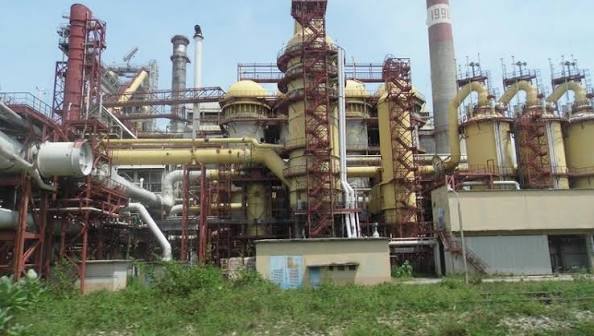
Nigeria’s steel paradox is as stark as it is familiar. A nation sitting on large iron ore deposits, generating scrap metal in industrial quantities and riding a construction boom still imports almost all the steel it consumes, draining an estimated four billion dollars from the economy every year. A newly published private framework is now arguing that the remedy does not lie where successive governments have kept looking, at the dormant Ajaokuta Steel Company, but in a cluster of smaller, modern plants built afresh alongside a national rail spine.
The proposal, styled the Nigeria Steel and Rail Transformation Initiative, was set out in a commentary published on Monday by a venture capitalist, Olusegun Ayo-Adebanjo. He described it as a fifteen year framework valued at N44tn, roughly 32 billion dollars, to build five modern steel mills across the country’s geopolitical zones and lay 5,000 kilometres of standard gauge rail connecting every major city and port. By his projection, the twenty year return across import savings, rail revenues, logistics efficiency and tax receipts would land between N82tn and N110tn, about 59.6 to 80 billion dollars, a payback of 2.5 to 3.4 times the investment before wider economic multipliers are counted.
At the centre of the plan is a deliberate break with the Ajaokuta model. “Ajaokuta is 45 years old, billions have been spent, and it has never produced a single tonne of commercial steel,” Ayo-Adebanjo wrote, framing the complex not as proof that Nigerian steel is unworkable but as evidence against one particular approach. In its place he proposed five Compact Strip Production mini mills sited in Lagos, Port Harcourt, Kano, Enugu and Delta State, each costing between 350 and 600 million dollars, producing one to 1.5 million tonnes annually and reaching first production within three to four years. Taken together, he put the five plants at two to three billion dollars, which he noted is less than half the minimum estimate for completing Ajaokuta, delivering seven to eight million tonnes a year and covering 75 to 90 per cent of the current import bill.
The mills, according to the proposal, would run on electric arc furnace technology fed by domestic scrap, a resource he said Nigeria currently exports cheaply despite abundant supply from construction and oil industry decommissioning. The fifth plant, in Delta State, is configured to roll heavy rail steel of the UIC 60 profile required for standard gauge track. Ayo-Adebanjo calculated that the 5,000 kilometres of planned rail would require about 600,000 tonnes of such steel, costing 600 million dollars if imported but 240 million dollars if produced locally, a saving he said would nearly repay that mill’s capital cost within eighteen months of full production.
The documented backdrop lends weight to his critique of Ajaokuta. Established in 1979 and designed for an eventual capacity of 5.2 million tonnes a year, the complex has remained largely non operational as a steel producer for more than four decades. Public records show the Federal Government allocated about N6.69bn to the company in the 2026 budget, with more than 90 per cent going to personnel rather than production. Between 2014 and 2024, roughly N29.11bn was spent on salaries and wages for redundant staff, with a further N9.8bn on allowances. The development economist, Professor Banji Oyelaran-Oyeyinka, told a virtual conference organised by the Coalition for the Revival of Ajaokuta in April that Nigeria had sunk an estimated ten billion dollars into the project without output, describing a country of more than 200 million people lacking primary steel production as “a travesty and a national embarrassment.”
Where the new blueprint parts company with much of the current policy conversation is on strategy. Oyelaran-Oyeyinka and others have pressed for Ajaokuta’s revival, arguing it could unlock as much as fourteen billion dollars annually and create tens of thousands of jobs, and some have called for its urgent privatisation. The Federal Government has itself leaned toward rehabilitation, with the Minister of Steel Development, Prince Shuaibu Abubakar Audu, confirming a memorandum of understanding signed in September 2024 with the plant’s original builders and the engagement of China as a strategic partner. The ministry has said the government is targeting ten billion dollars in direct steel sector investment by 2030. Ayo-Adebanjo’s argument is that the country should stop waiting on the old complex and build parallel capacity now.
Private capital is already moving in that direction. The Inner Galaxy Group broke ground on a 400 million dollar Stellar Steel plant in Ogun State, expected to be commissioned in April 2026, part of a wider wave of galvanising and rolling investments. Even so, Nigeria’s competitive position has slipped. Industry figures citing World Steel Association data indicate the country has fallen to fifth place in African steel output, with Libya among those that have overtaken it.
The rail half of the proposal speaks to a separate and long running national bottleneck. Ayo-Adebanjo noted that about 90 per cent of Nigeria’s freight moves by road, and put the logistics waste around the congested Apapa port corridor at roughly two billion dollars a year. His network targets six corridors, led by a Lagos to Kano spine of about 1,100 kilometres, a Port Harcourt to Maiduguri line of 1,300 kilometres routed past the Itakpe iron ore deposits, and a 300 kilometre Itakpe to Warri link tying ore to steelworks to port, alongside a Calabar to Lagos coastal route, a Kano to Maiduguri line and about 1,000 kilometres of branch and urban connections, all in 1,435mm standard gauge.
Here again the ground reality is documented. Nigeria’s standard gauge programme has advanced in segments rather than as a finished network. The Abuja to Kaduna line has run since 2016, the Warri to Itakpe line since 2020 and the Lagos to Ibadan line since 2021, while the Kaduna to Kano segment reached completion or advanced completion by early 2026, according to the Nigerian Railway Corporation. The bulk of the older national network, some 3,500 kilometres, remains narrow cape gauge, and South Africa still operates Africa’s most extensive rail system. Ayo-Adebanjo’s revenue case rests on the network hauling 80 million tonnes of freight a year at an average distance of 360 kilometres, priced at N68.75 per tonne kilometre, which he benchmarked against Kenya’s standard gauge railway, Ethiopia’s Addis to Djibouti corridor and South Africa’s Transnet, and set below Nigeria’s road freight cost. On that basis he projected roughly N1.38tn, about one billion dollars, in annual freight and passenger revenue at full operation in year fifteen, noting that Kenya’s 472 kilometre line alone earns some 200 million dollars a year.
On financing, the proposal leans heavily on blended capital rather than the treasury. Each mill would be structured as an independent special purpose vehicle so that a single failing plant cannot pull down the others, with senior debt from the African Development Bank and the International Finance Corporation covering half of each, Nigerian pension funds, which manage about N22tn, taking the mezzanine layer, domestic private equity holding 15 per cent, a foreign strategic partner such as Tata Steel, ArcelorMittal or SMS Group bringing technology and an offtake agreement for a tenth, and government grants covering five per cent. Rail, he wrote, would draw on a World Bank Programme for Results facility, an African Development Bank line, China EXIM funding for the northern corridors and sovereign green bonds backed by future track access charges.
The macroeconomic frame around such figures is shifting in Nigeria’s favour but remains tight. The naira traded at about N1,380 to the dollar at the official Nigerian Foreign Exchange Market window in late July 2026, close to the N1,375 mid rate the author applied from May, while external reserves climbed to 51.92 billion dollars as of July 16. Inflation eased to 15.91 per cent in June, according to the National Bureau of Statistics, though the benchmark interest rate stood at 26.50 per cent ahead of the Central Bank’s July policy meeting, a cost of capital that would weigh on any long horizon industrial financing.
The proposal is candid about one binding constraint that money alone cannot solve. Ayo-Adebanjo estimated that Nigeria has only 1,500 to 3,000 registered metallurgical engineers, far short of what five mills would demand, and suggested importing senior expertise on knowledge transfer contracts while building local capacity through a National Steel Training Institute and 500 federal scholarships a year. He described the shortfall as solvable but urgent.
What the document represents, ultimately, is a business case rather than an adopted policy. The full framework, its author noted, is available on request, and its projections have not been independently costed or endorsed by government. Nigeria’s steel and rail landscape is littered with ambitious targets that slipped, from Ajaokuta’s original phasing to repeatedly extended rail completion dates, and the financing model depends on partners and instruments that are not yet committed. Its central contention, that the country should stop treating a single Soviet era complex as the sole gateway to domestic steel, nonetheless lands in a live national debate over how a nation that makes almost none of its own steel should finally start.