
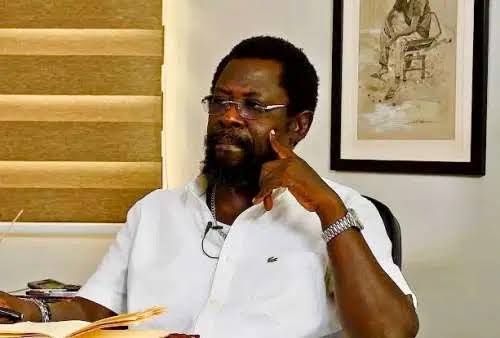
Human rights lawyer and activist Dele Farotimi’s description of social media personality Martins Vincent Otse, popularly known as VeryDarkMan, as the “hope of the common man” has reopened a wider question about public confidence in Nigeria’s justice system, particularly as the activist’s appearance at the Nigerian Bar Association’s 66th Annual General Conference generated debate within and beyond the legal profession.
Farotimi made the remarks in a video published on Saturday while discussing the controversy surrounding Otse’s invitation to the NBA conference in Port Harcourt. He argued that the growing influence of social media activists reflects public frustration with formal institutions for resolving grievances.
The comment is a political and social assessment by Farotimi, rather than an established finding that VeryDarkMan has replaced the courts. Available evidence, however, shows that questions about access to justice, delays, cost, equality before the law and confidence in courts remain significant in Nigeria and across Africa.
The NBA’s 66th Annual General Conference, held in Port Harcourt from August 21 to 28, 2026, was themed “Beyond Limits”. Its official programme included discussions on democracy, governance, policing, elections and the legal profession. Otse participated in a panel on insecurity, where he discussed his experiences documenting attacks and visiting affected communities.
His participation subsequently drew criticism from some lawyers, including Senior Advocate of Nigeria Femi Falana, who questioned the decision to invite him. Other reactions defended the inclusion of voices outside the conventional legal profession.
Farotimi’s argument goes beyond the conference controversy. He said a society with effective law enforcement and courts would have less need for personalities who publicly intervene in disputes and grievances.
“There will be multiplicities of VDM in the society that you have built,” he said, warning that more influential activists could emerge if institutional problems remained unresolved.
Recent evidence provides a more complicated picture than the claim that Nigerians have simply abandoned the courts.
A 2026 Afrobarometer study covering 38 African countries found that only 50 per cent of respondents, on average, believed ordinary citizens could obtain justice through the courts. Only 43 per cent believed court cases were likely to be resolved within a reasonable time, while 59 per cent said people were often or always treated unequally under the law.
Nigeria’s figures were considerably weaker on some of these measures. Afrobarometer’s 2024/2025 survey found that only 28 per cent of Nigerians expressed confidence that ordinary citizens who were wronged could obtain justice through the courts, placing Nigeria among the lowest ranked countries surveyed on that measure.
Trust in the courts has also changed over time. Afrobarometer’s 2000 Nigerian survey recorded 53.5 per cent expressing some or a lot of trust in the courts. By its 2022 survey, the corresponding figures had fallen to 26.8 per cent, based on respondents who said they trusted the courts “somewhat” or “a lot”.
The decline should not, however, be interpreted as evidence that Nigerians no longer use or believe in formal justice. It indicates weaker confidence and highlights persistent concerns about how the system works.
Nigeria’s own judicial policy recognises that delays and case backlogs are longstanding problems.
The National Judicial Council’s National Judicial Policy requires judiciaries to develop strategies for clearing civil cases pending for more than three years and criminal cases pending for more than 18 months. The policy also calls for more judges, improved court infrastructure, greater use of technology, alternative dispute resolution and better public access to legal information.
The NJC has also taken disciplinary action against judicial officers where misconduct was established. At a 2025 meeting, the Council considered investigation reports on petitions involving judges and imposed sanctions in cases where misconduct was found, while dismissing others for reasons including lack of merit or insufficient prosecution.
At the broader rule of law level, Nigeria ranked 120th out of 143 countries in the 2025 World Justice Project Rule of Law Index, although its overall score improved by less than one per cent. The index also recorded wider global concerns about judicial independence and civil justice.
These figures do not establish that Nigeria’s judiciary is “useless”, nor do they prove that social media personalities provide more reliable justice than courts. They do show that delays, affordability, perceived inequality and institutional trust remain important weaknesses.
That distinction is crucial because social media activism and judicial authority perform fundamentally different functions. A social media personality can draw public attention to an alleged injustice, pressure institutions to respond and amplify the complaints of people who might otherwise struggle to be heard. A court, however, operates under constitutional powers and legal procedures, with decisions subject to established rules of evidence, appeal and judicial review.
The growing visibility of personalities such as VeryDarkMan therefore presents less a replacement of the judiciary than a measure of how Nigerians are increasingly using alternative channels to seek attention and redress.
Farotimi’s intervention has consequently shifted the debate from whether one social media activist deserves a place at a lawyers’ conference to a larger institutional question: what happens to public confidence when citizens believe that going viral can produce a faster response than going to court?
The answer will depend not on the popularity of individual activists, but on whether Nigeria’s justice institutions can continue improving their speed, accessibility, accountability and public confidence.