
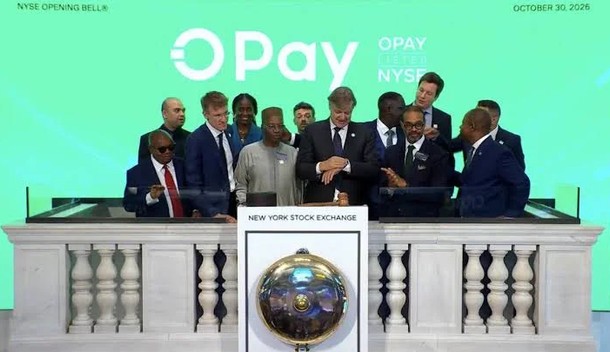
Financial technology giant OPay made its debut on the New York Stock Exchange on 30 October 2026, raising 304 million dollars through an initial public offering that values the firm at 4 billion dollars. Co-Chief Executive Officer Lars Rahbaek Boilesen joined veteran Nigerian regulator Shamsuddeen Usman in Manhattan to ring the opening bell under the ticker symbol OPAY. The firm sold 16 million American depositary shares at 19 dollars each, settling at the bottom end of its target price range.
Clearing a major Wall Street listing during a global tech sell-off demonstrates the immense cash generation power of West African consumer finance. US public markets have remained cold to emerging market listings due to sticky inflation and volatile tech valuations. Yet OPay used its scale in high-frequency retail transfers to convince global institutional managers to back the offering. The successful stock sale doubles the company’s 2 billion-dollar valuation recorded during its 2021 funding round.
Nigeria forms the financial heart of the platform, supplying over 88 per cent of corporate revenues in 2025. Millions of unbanked traders and daily wage earners turned to OPay during the chaotic 2023 naira cash crunch to keep micro-transactions moving. The app currently boasts over 50 million active monthly users across Nigeria, Egypt, Pakistan, and Indonesia. Low average ticket sizes near six dollars per transfer produce steady transaction fee income across vast merchant networks.
SoftBank and other early venture backers secured significant paper gains as trading commenced on the floor of the exchange. Lead underwriters Citigroup, Deutsche Bank, and Standard Bank retain a 30-day option to issue 2.4 million additional shares to meet surplus investor demand. Fresh capital from American equity markets gives management a deep war chest to fund credit expansion and corporate acquisition targets. The capital injection also strengthens operational buffers against sharp foreign exchange shifts in African markets.
Traditional commercial banks in West Africa now face a formidable public competitor with direct access to US capital markets. Conventional lenders spend heavily to maintain physical brick-and-mortar branches while losing retail market share to nimble mobile wallets. OPay processes peer-to-peer transfers, merchant payments, and micro-savings inside a single lightweight mobile application. Access to cheaper international capital allows the fintech operator to offer aggressive interest yields on user deposits.
The Wall Street listing sets a clear operational benchmark for African technology firms seeking exit liquidity abroad. High-growth startups must prove clear paths to profitability and massive transaction volume to win over skeptical foreign asset managers. OPay proved that serving informal micro-enterprises inside emerging economies can generate institutional-grade market valuations. Executive teams across Lagos and Nairobi will study the listing as they prepare their own corporate transition plans.