
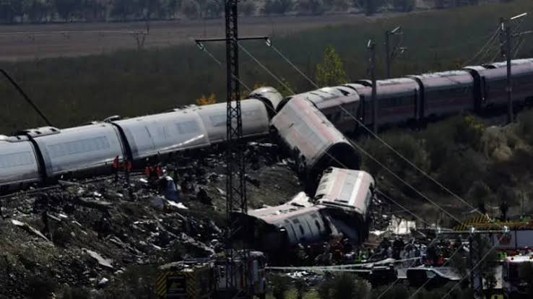
Spain’s transport minister rejects resignation calls as the country mourns at least 69 victims killed in a high-speed rail collision near Toledo, the nation’s worst train disaster in over a decade.
Emergency response teams pulled debris from the mangled wreckage of two high-speed passenger trains near the central Spanish town of Urda, marking the aftermath of one of the deadliest rail catastrophes in modern European history.
The collision occurred Wednesday morning when a state-operated Renfe train travelling between 160 and 200 kilometres per hour ploughed into the rear of a stationary Iryo company train, embedding its leading carriage deep into the stalled rolling stock.
Crisis at the Transport Ministry
As the national death toll reached at least sixty-nine victims, public outrage focused heavily on Spain’s transport infrastructure and political leadership. Demonstrators gathered outside the transport ministry in Madrid to demand accountability, while political opposition parties and the CSIF trade union formally called for the immediate resignation of Transport Minister Óscar Puente.
Addressing a press conference in Madrid, Puente firmly rejected those demands, stating that stepping down would be the easiest personal option but emphasising that his immediate responsibility is resolving the crisis.
“My duty right now is not to talk about whether I should remain in my position, but to resolve the problem,” Puente told reporters, adding that he had “nothing to hide” as investigations proceed.
Prime Minister Pedro Sánchez acknowledged that public trust in the country’s high-speed rail network is broken, pointing out the alarming reality of two major disasters on the Madrid-Seville route within a single year, following a January collision in Adamuz that claimed forty-six lives.
System Failures and Leaked Audio
Preliminary findings released by transport investigators point to a computer failure at approximately 08:30 on Wednesday morning that initially halted six moving trains on the network.
Leaked audio recordings published by local media revealed communications between the Madrid control centre and train drivers minutes before impact, appearing to show that dispatchers cleared a moving train to proceed despite another convoy remaining stationary twenty-five kilometres ahead. Puente previously described the decision to restart traffic without speed restrictions as inexplicable.
While politicians from various parties debated the release of the confidential recordings—with some condemning the leaks while others raised concerns about the broader liberalisation of the railway sector—Puente insisted he would not scapegoat individual workers.
“If the investigation shows there is human error, we will act in consequence of that,” Puente stated, noting that authorities refuse to use employees as shields while complex systemic questions are addressed.
National Grief and Unanswered Questions
Spain has entered three days of official national mourning as families struggle to identify victims and locate missing relatives. Among the confirmed dead are a 24-year-old athlete and a former government minister, though dozens of families remain desperate for official information regarding missing passengers.
Esther San Emeterio, whose 54-year-old brother Pepe remains unaccounted for, expressed deep anguish over the prolonged wait for answers from authorities in Toledo province.
“We went to bed crying, outraged and full of shame,” San Emeterio said. “We are desperate, and I want all of Spain to know. How can they keep us like this?”
As forensic teams continue identification work and technical investigators examine signalling logs, the political debate over rail safety, corporate restructuring, and ministerial accountability intensifies across the nation.