
ByN’Mazi Obiomah O. Igbokwe
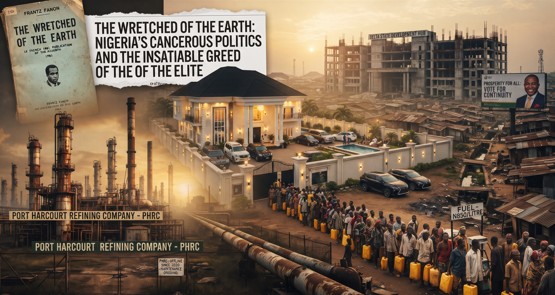
Frantz Fanon’s The Wretched of the Earth, published in 1961, is more than a revolutionary text about colonial oppression. It is a warning about what happens when those who inherit political independence reproduce the same structures of exploitation they once promised to dismantle. In Nigeria, where immense natural wealth coexists with widespread hardship, Fanon’s analysis offers a disturbing lens through which to examine the cancerous nature of politics and the insatiable appetite of the ruling elite.
Nigeria gained independence in 1960, promising its citizens dignity, prosperity and self-government. Yet decades later, the question remains: independence for whom exactly?
When independence changes the beneficiaries, not the system
Fanon warned that a postcolonial national bourgeoisie could replace the departing colonial rulers without transforming the economic structures that impoverished the masses. Rather than building productive industries and expanding opportunities, this elite could become preoccupied with controlling the state and distributing its privileges among itself. Sadly, this is the case in Nigeria today.
Nigeria’s dependence on crude oil illustrates this danger. Despite possessing enormous petroleum resources, the country spent decades importing much of its refined fuel while its four state-owned refineries endured prolonged shutdowns and rehabilitation efforts. The US Energy Information Administration reports that the refineries, with a combined nameplate capacity of 445,000 barrels per day, had remained offline for long-term maintenance or rehabilitation since 2020, with intermittent operations at reduced capacity.
The contradiction is staggering. An oil-producing country should not perpetually struggle to convert its natural resources into affordable energy, industrial development and decent jobs. The failure is not simply technical; it raises fundamental questions about policy consistency, public expenditure, institutional accountability and the interests served by successive governments.
The beneficiaries of a dysfunctional system may be few, but its costs are borne by millions.
The fuel subsidy: hardship at the bottom, accountability at the top
On 29 May 2023, President Bola Tinubu announced the removal of the petrol subsidy. The reform addressed a costly fiscal arrangement, but its immediate consequences were devastating for households already struggling with rising living costs.
Transport fares increased, food distribution became more expensive, and small businesses dependent on petrol-powered generators faced mounting operating costs. The World Bank reported in December 2023 that retail petrol prices had risen by an average of 163 per cent following the reform, alongside substantial currency depreciation. It stressed the need for measures to protect vulnerable households.
The question is not whether every subsidy was economically sustainable. It is whether the burden of reform was matched by transparent management of the resulting savings, credible social protection and visible improvements in public services.
When citizens are asked to endure sacrifice, they are entitled to demand evidence that the sacrifice serves the national interest. Where are the measurable improvements in public transport, electricity, healthcare and employment? How effectively are support programmes reaching the poorest households? What safeguards ensure that savings are not swallowed by wasteful expenditure elsewhere?
Reform without accountability risks becoming another exercise in transferring hardship downward while leaving entrenched privilege largely undisturbed.
A legislature and a nation of unequal sacrifices
The contrast between public hardship and the cost of political institutions is equally troubling.
An analysis of Nigeria’s 2024 budgets published by The Punch reported that the National Assembly, the 36 state assemblies and their related agencies had approximately ₦724 billion allocated to them that year. The report estimated that lawmakers’ salaries and allowances alone would cost about ₦50 billion.
These figures do not, by themselves, establish that the expenditure was unlawful or that every allowance was unjustified. Legislatures require funding to perform their constitutional responsibilities. The legitimate question, however, is whether such expenditure delivers value commensurate with its cost.
Can Nigerians reasonably demand transparency over legislative spending? Should constituents not be able to assess lawmakers by the quality of legislation, effective oversight, constituency development and the scrutiny of executive expenditure?
A democracy becomes distorted when political office is perceived primarily as a pathway to comfort rather than a responsibility to the public.
Politics as a malignant growth
Political corruption resembles cancer because it can spread beyond individual wrongdoing and progressively weaken the institutions meant to restrain it.
Consider the recurring allegations surrounding inflated contracts, abandoned public projects, opaque procurement and the diversion of public resources. Each poorly executed road, unequipped hospital or inadequately staffed school represents more than an administrative failure. It represents an opportunity lost to improve human lives.
When contracts are awarded on the basis of political loyalty rather than competence, public infrastructure becomes a vehicle for patronage. When oversight is compromised, waste can become normalised. When accountability depends on political affiliation, the law risks becoming an instrument applied selectively rather than a standard applied equally.
This is the deeper relevance of Fanon’s argument: changing the individuals who occupy public office cannot transform society if the institutions and incentives that reward extraction remain intact.
The cancer is not every politician, nor is it politics itself. It is a political culture that allows private enrichment to flourish at the expense of public responsibility.
The betrayal of the Nigerian people
The consequences are visible in the everyday experiences of Nigerians. Parents struggle to pay school fees while graduates search for work. Patients confront the cost of medical treatment. Farmers contend with insecurity and disrupted livelihoods. Young professionals consider emigration because they see greater opportunities elsewhere.
These realities exist alongside the enormous potential of a country blessed with human ingenuity, agricultural possibilities, a large domestic market and substantial natural resources.
Fanon understood that prolonged oppression damages more than material well-being; it also erodes dignity and confidence in the possibility of change. When young Nigerians repeatedly witness unfulfilled promises and apparent impunity, they may begin to question whether hard work, education and civic participation can meaningfully improve their circumstances.
That loss of faith is dangerous. A country cannot sustainably develop when its citizens cease to believe that its institutions belong to them.
Breaking the cycle
Nigeria does not need merely to replace one set of political officeholders with another. It needs a transformation in the relationship between power and public service.
Public procurement must be transparent. Legislative and executive spending must withstand meaningful scrutiny. Anti-corruption institutions must act impartially. Oil revenues must produce measurable public benefits. Governments must publish credible evidence of how savings from major economic reforms are used.
Above all, Nigerians must resist the temptation to defend political failure because its perpetrators share their ethnicity, religion or region. No community benefits in the long term from a leader who impoverishes the nation.
Fanon’s The Wretched of the Earth reminds us that political independence is incomplete when the structures of exploitation survive under new management.
Nigeria’s tragedy is not a lack of resources or capable people. It is the persistent gulf between what the nation possesses and what its citizens experience.
Until public office becomes an instrument of service rather than a means of private accumulation, the cancer will continue to spread through the body politic. And the people who should be the ultimate beneficiaries of independence will remain its most neglected casualties.