
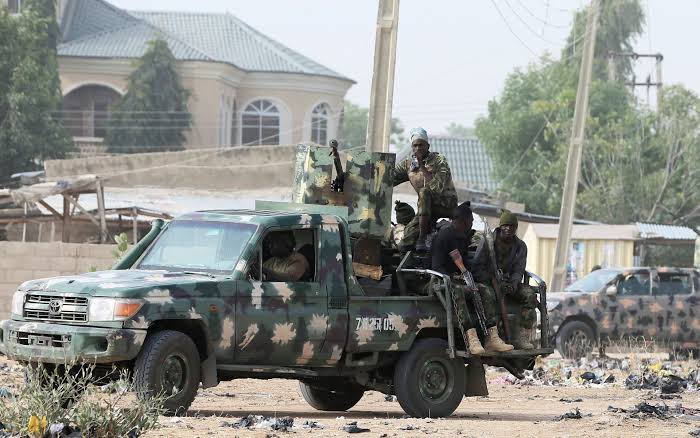
United States forces are training Nigerian troops in drone operations, battlefield medicine and explosives handling at a base in Bauchi State, a sign that military cooperation between the two countries has settled into a durable partnership even after Washington pulled back most of the combat forces it deployed earlier this year.
The exercises, described in a report by the United States Africa Command, form part of a broader security cooperation mission at what the command calls Operating Location Bauchi. According to AFRICOM, the training has covered Combat Lifesaver and Tactical Combat Casualty Care instruction, weapons familiarisation, camouflage, water treatment and testing, explosive ordnance disposal, small unit tactics and unmanned aircraft systems. The command said the topics were chosen jointly, with American units offering options and Nigerian commanders selecting those they considered most useful.
Drone instruction drew particular interest. According to the report, Sergeant Mark Murphy, an intelligence analyst assigned to the 13th Combat Sustainment Support Battalion, led about 10 members of the Nigerian Air Force Special Forces Regiment through unmanned aircraft systems training that began with roughly 45 minutes of instruction before moving to hands on practice. “They were really excited with being able to get hands-on time with it,” Murphy was quoted as saying, adding that the personnel wanted further training on the system.
Captain Gabriel Feingold, an operations officer at the location, said the approach was demand led. “We bring them a list of several different training topics, and they select what they think would be most beneficial for them,” he said. The report noted that American soldiers involved were drawn from the 2nd Battalion, 503rd Parachute Infantry Regiment, and that troops from both countries also played basketball and volleyball when conditions allowed, to build rapport.
The training footprint is what remains of a much larger American presence that arrived at the start of 2026. The deployment began with what the US described as a small team in early February, following an agreement reached after an American strike on suspected ISIS fighters that President Donald Trump said were targeting Christians. By mid February, Premium Times reported that about 200 US troops were on the ground.
That surge has since been scaled back. In early July, the AFRICOM commander, General Dagvin Anderson, told a virtual briefing after the African Chiefs of Defence Conference in Luanda, Angola, that the US had “withdrawn much of our forces that were just there for that operation,” while retaining intelligence sharing and other cooperation at Nigeria’s request. An AFRICOM spokesman said the partnership remained strong and that American personnel stayed in the country at the invitation of the government, with numbers fluctuating according to need. More than 100 service members are understood to remain on a training and advising mission.
Nigerian authorities have been careful to frame the presence in limited terms. In February, the Director of Defence Information, Major General Samaila Uba, confirmed that US troops were in the country but dismissed suggestions of combat deployment, saying their role was restricted to capacity building, professional military education, intelligence sharing, logistics support and strategic dialogue.
The training carries significance beyond the tactical because it sits within a wider diplomatic frame. Military cooperation is one of three priority areas agreed by both governments after the United States returned Nigeria to its list of Countries of Particular Concern on 31 October 2025. The designation, provided for under the International Religious Freedom Act, applies to states judged to have engaged in or tolerated serious violations of religious freedom, and it opened a period of intense engagement between Abuja and Washington.
To manage that relationship, the two sides established a Joint Working Group. Its first session was held in Abuja on 22 January 2026 and its second in Washington on 12 August 2026, led on the American side by Under Secretary of State for Political Affairs Allison Hooker and on the Nigerian side by the National Security Adviser, Nuhu Ribadu. According to the State Department, the talks centred on protecting communities in the Middle Belt, holding perpetrators of violence accountable, and cooperation between the two militaries. The Bauchi exercises are the operational face of that third strand.
The partnership is not new. The United States has worked with Nigeria against Boko Haram and its Islamic State affiliate since the insurgency escalated after 2009. According to a resolution before the US House of Representatives, the Department of Defense has committed more than 83.5 million dollars in military and security assistance to Nigeria since the 2020 financial year. AFRICOM has also credited a spring 2026 campaign around the Lake Chad Basin with degrading ISIS leadership in the region, an operation the recent deployment supported.
What is confirmed is that a training and advising mission continues, that drone, medical and demolition skills are being transferred to Nigerian units, and that both governments describe the cooperation as ongoing and mutually agreed. What remains open is the future scale of the American presence, which officials say will rise and fall with operational demand, and the outcome of the annual CPC review due in November, which will test how far Abuja’s security efforts have satisfied Washington.
For Nigerian forces stretched across multiple fronts, from the north east to the Middle Belt, the immediate value lies in capability rather than politics. Skills such as drone reconnaissance and combat casualty care address gaps that commanders themselves identified, and the steady rhythm of joint training at Bauchi suggests a relationship built to outlast any single operation or designation.