
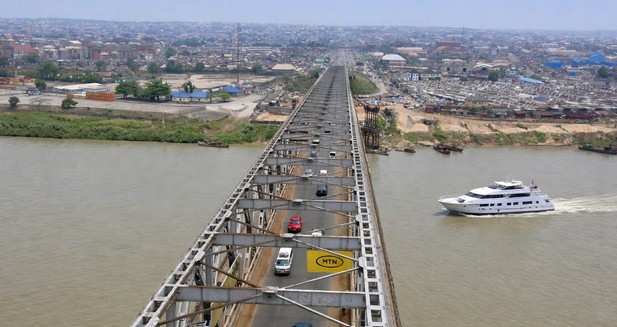
Federal authorities have ordered the closure of the First Niger Bridge for two weeks, cutting off the historic primary link between Asaba and Onitsha. The Federal Ministry of Works cited severe carriageway degradation and extensive structural vandalism, most acutely the stripping of stanchion bolts, steel truss components, and expansion joint fixtures by scrap scavengers, as the justification for an emergency contractor arrangement. All interstate freight and vehicular movements have been ordered onto the Second Niger Bridge via the Obosi bypass. While official statements treat the intervention as public protection, the sudden restriction of the crossing brings into sharp relief a persistent policy failure in Nigerian transport governance: the habit of ignoring asset decay until infrastructure reaches the point of physical emergency.
The Onitsha-Asaba crossing is the economic carotid artery between the manufacturing, maritime import hubs of the South-West and the vast commercial distribution circuits of the South-East and South-South. More than fifty-five thousand vehicles, ranging from forty-tonne articulated flatbeds to commercial commuter buses, cross the Niger daily along this axis. Yet for years, federal road agencies treated the 1965 cantilever truss bridge as an unyielding asset that required zero preventative care until structural distress became obvious to the naked eye. The routine response from Abuja has been late-stage panic, followed by ad-hoc closures and hurried repairs. In an economy where logistics expenses already consume up to thirty-five per cent of total wholesale goods pricing, transforming a scheduled maintenance programme into an emergency shutdown directly inflates consumer prices nationwide.
The Freight Diversion Arithmetic and Transport Surcharges
Directing heavy articulated traffic away from the First Niger Bridge onto the Second Niger Bridge appears seamless on an official route map. On the asphalt, the operational economics tell an entirely different story. The Second Niger Bridge was built as an external bypass, designed to keep inter-regional through-traffic away from the urban congestion of downtown Onitsha and Asaba. Diverting internal and local freight through this route forces freight hauliers into an immediate detour of between fifteen and twenty-eight kilometres, depending on terminal destinations around the Onitsha Main Market, Bridgehead, or Upper Iweka.
For a haulage firm operating heavy diesel trucks, that geographical detour represents a significant cash penalty. At current retail rates for automotive gas oil, an additional twenty-kilometre crawl in bumper-to-bumper diversion traffic consumes dozens of litres of supplementary fuel per single passage. Haulage unions and owner-operators do not absorb these running costs. Within forty-eight hours of diversion orders taking effect, transport syndicates impose freight surcharges on wholesale distributors. A consignment of cement, corrugated iron sheets, or imported chemicals moving from Lagos or Ogun to warehouses in Anambra and Enugu immediately accrues an additional freight tariff.
The structural arrangement also creates immediate tolling friction. While the federal government has suspended or deferred full automated toll collections during previous bypass handovers, the lack of a permanent, unified tolling policy introduces friction. Commercial operators face a choice between long queues on diversion access ramps or the prospect of unbudgeted transit levies. The diversion routes around the Obosi interchange and the Asaba approaches are already showing signs of rapid surface deterioration under heavy axial loads. Roads designed for moderate suburban traffic are now absorbing the unmitigated impact of heavily laden long-distance tankers, accelerating secondary road damage across both riverbanks.
The Pathology of Emergency Contracts Versus Predictive Systems
The fundamental scandal of the First Niger Bridge is not that steel fatigues or asphalt wears thin; it is that the Nigerian state only notices the decay when scavengers saw off structural bolts. In mature transport economies, major river crossings operate under automated Bridge Management Systems (BMS). These frameworks deploy acoustic sensors, laser displacement gauges, and regular non-destructive testing to monitor steel corrosion, thermal expansion stresses, and weight fatigue in real time. Maintenance is scheduled months in advance, performed during off-peak night hours, and executed without obstructing regional commerce.
Nigeria, by contrast, operates an extractive, crisis-driven model of public works. Routine preventative maintenance receives negligible allocations in annual federal appropriations. When funds are voted, they are routinely stalled in the bureaucratic approvals of the Federal Ministry of Works. Maintenance becomes an attractive budgetary item only when physical deterioration advances to the precipice of catastrophe. At that juncture, the technical intervention ceases to be a planned civil engineering task and becomes an “emergency procurement.”
Emergency contracts circumvent standard competitive bidding guidelines under the Public Procurement Act. They invite inflated cost structures, opaque variation orders, and rapid mobilisation advances to contractors who frequently lack specialised bridge engineering expertise. The contractor handling the Onitsha-Enugu dual carriageway has been instructed to patch the river crossing as an addendum to an existing road contract. This cyclical pattern of neglect, structural alarm, panic contract award, and temporary patching guarantees that the First Niger Bridge will return to acute distress within another three to four years. The bridge is treated not as a strategic asset to be preserved, but as an intermittent budgetary crisis to be monetised.
Quantifying the Corridor Toll: The Cost of Commercial Inertia
The economic damage of traffic disruption on the Onitsha-Asaba axis extends far beyond the repair bill itself. Regional logistics analysts estimate that the commercial ecosystem linking the South-East to Western and Northern consumer belts loses between N1.8 billion and N2.4 billion every single day when this corridor suffers systemic gridlock.
The Onitsha Main Market, widely regarded as the largest informal retail exchange in West Africa, depends entirely on fluid, daily turnaround times. Wholesalers in Onitsha rely on raw materials and finished goods that arrive from the ports of Lagos, while agricultural produce and livestock move across the river from the North and Middle Belt. When the crossing narrows or stalls, supply chains freeze. Perishable agricultural goods, tomatoes from Kano, cattle from Adamawa, and plantains from Edo, rot in stationary haulage trucks under the sun. The financial losses fall squarely on informal traders and agricultural intermediaries who lack insurance instruments or cold-chain storage.
At the same time, factory production lines inside the industrial clusters of Nnewi and Harbour Industrial Estate in Onitsha face material shortages. Factory managers report that production runs are regularly delayed because semi-processed chemical compounds, rubber, and steel components are stuck on the western approaches to the river. Workers sit idle while overheads run continuously. When logistics operators eventually discharge their cargo, they pass the demurrage costs down the value chain. By the time a manufactured item or a sack of staple food reaches the retail market stall in Aba, Owerri, or Awka, the consumer pays the financial penalty for every hour a truck spent idling on the bridge approach.
The Institutional Path Ahead
Patching asphalt and spot-welding vandalised stanchions will not solve the underlying infrastructure governance failure. The two-week closure must serve as an indictment of the way the federal government stewards critical physical assets. National transit infrastructure cannot remain at the mercy of scrap metal thieves, bureaucratic indifference, and eleventh-hour executive inspections.
The Federal Ministry of Works must permanently divest itself of direct, bureaucratic bridge maintenance. Strategic crossings across the Niger, Benue, and coastal waterways should be placed under a dedicated National Bridge Authority or long-term public-private maintenance concessions with strict performance benchmarks. Such frameworks must mandate round-the-clock physical and electronic security surveillance, ending the brazen vandalism that robs public infrastructure of its load-bearing steel. Preventative upkeep must be financed through dedicated asset-preservation sinking funds rather than discretionary annual budget releases. Until Nigeria adopts predictive engineering systems and discards the profitable business of emergency repairs, its primary economic trade corridors will remain hostage to foreseeable breakdowns and unmanageable commercial costs.