
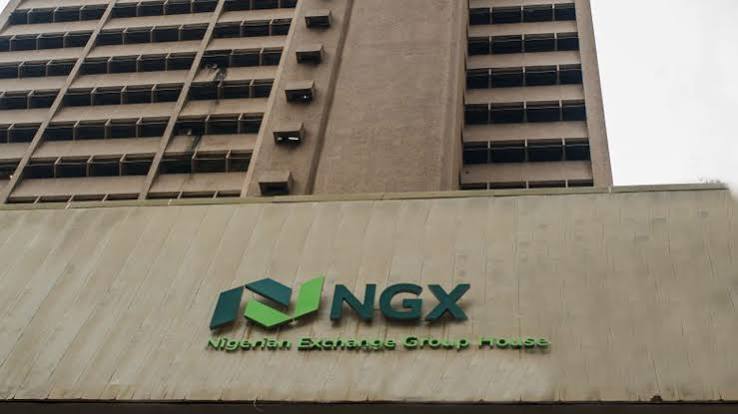
Nigeria’s equities market has pulled back from the record highs it set earlier in August, as investors lock in gains from one of the strongest rallies the Nigerian Exchange has recorded in years. Even after a run of losing sessions, however, the market remains far ahead of where it started the year, leaving analysts to debate whether the slide is a healthy correction or the beginning of a longer cooling.
The Nigerian Exchange, NGX, All-Share Index, the main gauge of share price movement, closed at about 239,055 points on Monday, 24 August 2026, according to market data, down roughly 0.12 per cent on the day. Overall market capitalisation, the total value of all listed shares, eased to about N154.4 trillion after shedding around N157bn in the session. It was the latest in a string of declines that had by then stretched into the market’s longest losing run of 2026.
The retreat followed a period of exceptional strength. The NGX Group told President Bola Tinubu at a State House briefing on 6 August that market capitalisation stood at N158.10 trillion as at 5 August, with the All-Share Index at 244,912.24 and a return of about 57 per cent in the first half of the year, one of the strongest showings among major global benchmarks over that period. By mid August the index had brushed record territory before the pullback set in.
Even after the slide, the market’s gains for the year remained substantial. Data cited across market reports put the year to date return at roughly 54 to 55 per cent as at late August, meaning most investors who held through 2026 are still sitting on considerable paper profits. The recent losses have trimmed the rally rather than reversed it.
Analysts attribute the decline mainly to profit taking after the record run, with investors selling to realise gains and rotating out of stocks that had climbed sharply. The selling has been broad. On Friday, 21 August, the index fell 0.29 per cent to 239,351.16 and capitalisation dropped N443.32bn, with decliners outnumbering gainers. The same negative breadth carried into the new week, where about 33 stocks fell against 18 that rose on Monday, according to market data. Some reports also pointed to caution over the wider political and economic calendar as a factor weighing on sentiment.
Financial stocks, which powered much of the 2026 advance, have been at the heart of the correction. The NGX Banking Index and the NGX Insurance Index both weakened as lenders and underwriters gave back earlier gains. In the trading captured by recent market data, Fidelity Bank fell 6 per cent to N18.80 and United Bank for Africa lost 1.44 per cent to N44.45, while Access Holdings rose 1.85 per cent to N27.50 and Guaranty Trust Holding Company added 0.55 per cent to N127.70. Insurance counters showed sharper swings, with International Energy Insurance among the heavier losers.
The banking sector’s prominence is tied to an ongoing recapitalisation exercise. The Central Bank of Nigeria in 2024 directed banks to raise their minimum capital, setting a threshold of N500bn for lenders holding international authorisation, with the process running through 2026. That programme has driven heavy activity in the primary market, where new shares are issued, and has kept banking stocks in focus. It helps explain both their earlier surge and their sensitivity to profit taking now.
The 2026 gains have been narrowly concentrated. As at 7 August, 25 companies were each valued at more than N1 trillion on the NGX, and together they accounted for more than 90 per cent of the exchange’s total market capitalisation, according to figures reported by market trackers. Those firms span telecommunications, banking, cement, energy, consumer goods and power. MTN Nigeria touched an all time high of about N605 during August, illustrating how a handful of large companies can move the headline index. The flip side is that when a few heavyweight stocks are sold down, the entire market feels it.
The direction of the market carries consequences well beyond the trading floor. The NGX is where governments and companies raise long term finance, and where pension funds, insurance firms and ordinary savers grow their money. A rising market lowers the cost of capital for businesses and lifts the value of retirement savings held in equities. A sustained fall does the reverse. The present episode matters because it tests whether the 2026 rally rested on durable fundamentals or on momentum that fades once buyers pause.
What is established is that the market climbed strongly through the first half of 2026, peaked in early August at close to N158 trillion in value, and has since retreated over several sessions on profit taking, while still holding gains of more than half its opening level for the year. What remains uncertain is how long the pullback will last. Market watchers say the next few sessions should show whether institutional investors return to large banking, energy and industrial names, which would steady the index, or whether the market settles into a longer consolidation. As with all equities, prices can move in either direction, and past performance is not a guarantee of future returns.