
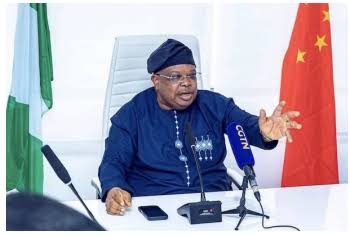
The Federal Government has approved the start of procurement for two new high-capacity transmission corridors, the East and West Super Grids, which it says will raise the amount of electricity the national grid can carry from about 5,000 megawatts to 19,000MW within two years. Minister of Power, Joseph Tegbe, announced the decision on Wednesday after the Federal Executive Council meeting presided over by President Bola Tinubu at the Presidential Villa, Abuja. If delivered on schedule, the target would nearly quadruple the grid’s current wheeling capacity.
Tegbe said the corridors would strengthen links from Sokoto through Abuja and other locations into parts of southern Nigeria. “The East and West Super Grids are not projects for one part of the country,” he said. “They cut across the north and south of Nigeria, strengthening the backbone that must carry power from where it is generated to where it is needed.”
The project goes to the heart of a mismatch that has defined the power sector for years. According to the minister, Nigeria has more than 13,000MW of available generation capacity, but the transmission network can reliably wheel only about 5,000MW. On those figures, roughly 8,000MW, or more than 60 per cent of available capacity, is effectively stranded at the plants. “We want a grid that can evacuate the power we already have, not one that leaves generation stranded while consumers remain in darkness,” Tegbe said.
The council also approved three smaller projects for Abuja and the Lagos axis, the country’s two biggest demand centres. The first is a 33kV double-circuit underground and overhead line connected to the Katampe Transmission Substation, a key hub for the North Central region. The second covers the supply of three 300MVA, 330/132/33kV transformers for the Ikeja West Transmission Substation, which feeds much of Lagos. The third will upgrade the 35.6-kilometre Itumola, Mapasin and Shagamu 132kV line from a single circuit to a double circuit to meet rising demand along the Lagos and Shagamu corridor.
“These are not glamorous projects, but they are the projects that determine whether power actually gets to the consumer,” the minister said. He added that the government was energising completed transmission substations in Kano, Katsina, Bauchi and Gombe, among others, so that idle infrastructure could be put to use. Construction has also begun on a new National Control Centre in Osogbo, replacing a facility Tegbe said was built 64 years ago.
The weakness of the grid has been on full display this year. Data from the Nigerian Independent System Operator (NISO) showed that the grid suffered a total collapse on January 23, 2026, with generation falling to zero and supply to all 11 distribution companies cut off by about 1pm. NISO attributed that failure to the tripping of multiple 330kV transmission lines and the disconnection of some generating units. Days later, another nationwide outage followed, which the operator traced to a voltage disturbance at the Gombe Transmission Substation.
The record had shown some improvement before then. The grid collapsed almost every month in 2024, while only two major collapses were recorded in 2025. Even so, disturbances have continued. NISO data showed that earlier this month, supply dropped from 3,647MW at noon to 675MW an hour later, a fall of about 81.5 per cent, before the operator announced that the grid had been stabilised.
Transmission is only one part of the problem. Tegbe disclosed that the government had paid ₦1.23 trillion of the ₦3.3 trillion owed to gas suppliers and other power sector creditors, leaving about ₦2.07 trillion, or roughly 63 per cent, outstanding. “We have paid N1.23 trillion, and we intend to finish the job. But we must also stop new debts from accumulating,” he said.
The size of the debt itself remains contested. President Tinubu approved the ₦3.3 trillion figure in April as the full and final settlement of verified legacy debts under the Presidential Power Sector Financial Reforms Programme. Generation companies, however, have put their total claims at about ₦6.8 trillion, and the Association of Power Generation Companies has questioned how the government arrived at its figure. In March, gas suppliers threatened to halt supply to thermal plants over unpaid bills, a serious risk in a system where gas-fired plants provide most of the grid’s electricity.
Tegbe said the government was reviewing the electricity market structure to enforce payment discipline and reduce the risk of fresh arrears. He also said a four-week audit was under way to identify ageing and weak transmission assets for replacement or rehabilitation. The minister did not disclose the cost of the super grids, their funding source or the timeline for completing procurement.