
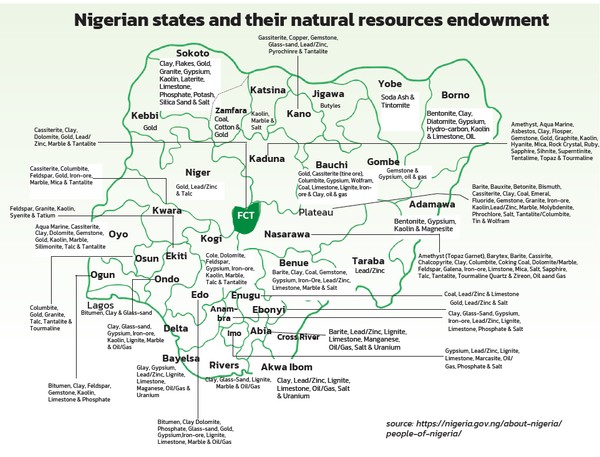
Fresh economic disclosures on subnational finance reveal an enduring paradox of the Nigerian federation. States endowed with vast deposits of critical minerals, lithium, tantalite, gold, lead, zinc, and rare-earth elements, continue to record near-negligible figures for internally generated revenue (IGR). From the lithium-heavy corridors of Nasarawa and Kwara to the goldfields of Osun and Zamfara, subnational balance sheets remain stagnant. Governors and finance commissioners still go to Abuja each month to queue for allocations from the Federation Account Allocation Committee (FAAC).
The official political discourse routinely celebrates prospective investments in mining hubs, heralding multi-million-dollar extraction deals as economic transformations. The fiscal reality exposes these announcements as administrative fiction. The constitutional concentration of solid mineral ownership in federal hands, coupled with broken local regulatory frameworks, has produced rentier states that host vast wealth extraction yet capture none of its fiscal value. The host communities absorb ecological damage, lost topsoil, and ruined water tables, while state treasuries remain dependent on federal redistributions of oil receipts.
Decoupling the Mining Regime for State Equity
This fiscal paralysis originated from the 1999 Constitution. Item 39 on the Exclusive Legislative List gives the federal government total control over mines, minerals, and natural gas. Under the Nigerian Minerals and Mining Act of 2007, the Ministry of Solid Minerals Development holds sole authority to issue exploration licences, mining leases, and quarrying permits. This federal monopoly strips state governments of legitimate direct claims over the minerals within their borders.
The path toward real fiscal federalism requires structural legislative reform to dismantle this legal barrier. The National Assembly must amend the Exclusive Legislative List, shifting mineral rights to the Concurrent Legislative List in line with the recent unbundling of electricity and railway networks. In the interim, the federal government should deploy a statutory co-equity model. Rather than confining federating states to the thirteen per cent derivation formula—a fund that is frequently delayed, disputed, or lost in the federation accounts—the regulatory framework should mandate that subnational governments hold a statutory carried equity share, between ten and fifteen per cent, in commercial mining ventures licensed in their territories.
Such equity participation gives subnational treasuries direct access to commercial dividends, board oversight, and joint-venture proceeds. This structure removes the status of the subnational state as a bystander and establishes a direct alignment between local development goals and commercial mining productivity. Without direct balance-sheet equity, mineral-rich states will continue to see wealth move from open pits straight to foreign industrial plants, leaving regional treasuries empty.
The Failure to Monetise Land-Administration Authority
While governors frequently complain about federal constitutional constraints, their own administrations have failed to deploy the powerful legal instruments already available to them. Under the Land Use Act of 1978, all land within a state is vested in the governor, who holds it in trust for the people. Federal mining leases grant subterranean mineral rights, but they do not confer unconditional surface rights. To clear brush, build haulage roads, erect processing structures, or store tailings, a commercial miner must obtain surface rents, rights of way, and governor’s consents.
State cabinets rarely transform these legal prerogatives into structured revenue channels. Instead of establishing unified, digital property and cadastral registries to track industrial operations, state land ministries run chaotic, paper-based bureaucracies. Informal artisanal cartels, frequently managed by networks of illicit actors and local elites, operate freely on community farmlands without official surface permits, local planning clearances, or standard property-tax levies.
States fail to monitor the heavy logistical footprints of mining operations. Fleets of articulated trucks carrying unrefined mineral ores degrade subnational road networks without paying environmental haulage charges, transit tolls, or local processing inspection fees. The failure of internal revenue services to tax the support ecosystems of the mining economy—equipment rentals, specialised transport services, temporary industrial housing, and chemical supply chains—proves that subnational revenue starvation is largely a failure of administrative will. Governors allow billion-naira supply networks to operate off the books, then rely on federal allocations to fund basic public payrolls.
Natural Resource Funds and Downstream Industrialisation
The extraction of non-renewable assets without permanent capital accumulation is a recipe for community ruin. Host towns across the Middle Belt and North-West bear visible scars: untreated open pits, cyanide-laced groundwater, child labour in artisanal shafts, and armed disputes over mining corridors. Once the deposits are exhausted, these communities face abandoned, toxic wastelands without viable alternative livelihoods.
To break this pattern, mineral-rich subnationals must establish dedicated Subnational Natural Resource and Future Generations Funds. These funds should receive a mandatory statutory percentage of all mining-related local revenues, surface rents, corporate social development levies, and environmental fines. The governance of these institutions must be insulated by law from the discretionary spending of executive governors, using clear fiduciary rules and independent oversight committees that include civil society, host-community representatives, and environmental scientists.
These funds should serve two structural purposes. The primary sleeve must serve as an ecological rehabilitation escrow, guaranteeing the complete restoration of strip-mined lands, the decontamination of local water tables, and the long-term reforestation of exhausted pits when mining companies inevitably default on their cleanup promises.
The secondary sleeve must finance localised industrial beneficiation hubs. Raw mineral exports provide the lowest economic returns while shifting manufacturing value abroad. Subnational natural resource funds should finance common-user industrial infrastructure—industrial power supply, central chemical testing laboratories, and secure freight aggregation hubs—to attract private processors. Nasarawa, Kogi, or Niger should not merely export raw lithium spodumene or raw lead concentrates; they should compel and support the local production of battery-grade lithium carbonate, industrial alloys, and refined metals. Downstream beneficiation transforms transient raw-material extraction into stable corporate taxes, skilled manufacturing jobs, and strong, self-sustaining local economies.
Ending Subnational Rentierism
The mineral-rich states of the federation cannot build modern public finances on the illusion of subterranean mineral wealth. A natural resource deposit under the earth is not balance-sheet capital; it is simply a physical asset waiting to be exploited. When federal legal monopolies combine with state-level administrative inertia, the outcome is systemic underdevelopment: private syndicates accumulate fortunes, national mineral registers display inflated export projections, and local populations sink further into poverty.
Nigeria cannot run a sustainable federation where regional leaders function merely as distribution agents for central government cheques. State governments must abandon their reliance on monthly fiscal allocations and aggressively exercise their sovereign land and planning powers to bring informal extraction into the formal tax net. At the same time, the federal government must yield its monopoly over solid minerals, opening the door to subnational equity ownership and true economic federalism. Until these legal and fiscal walls are brought down, the phantom wealth of Nigeria’s mineral belt will enrich only shadow cartels, while the states themselves remain fiscal paupers.